
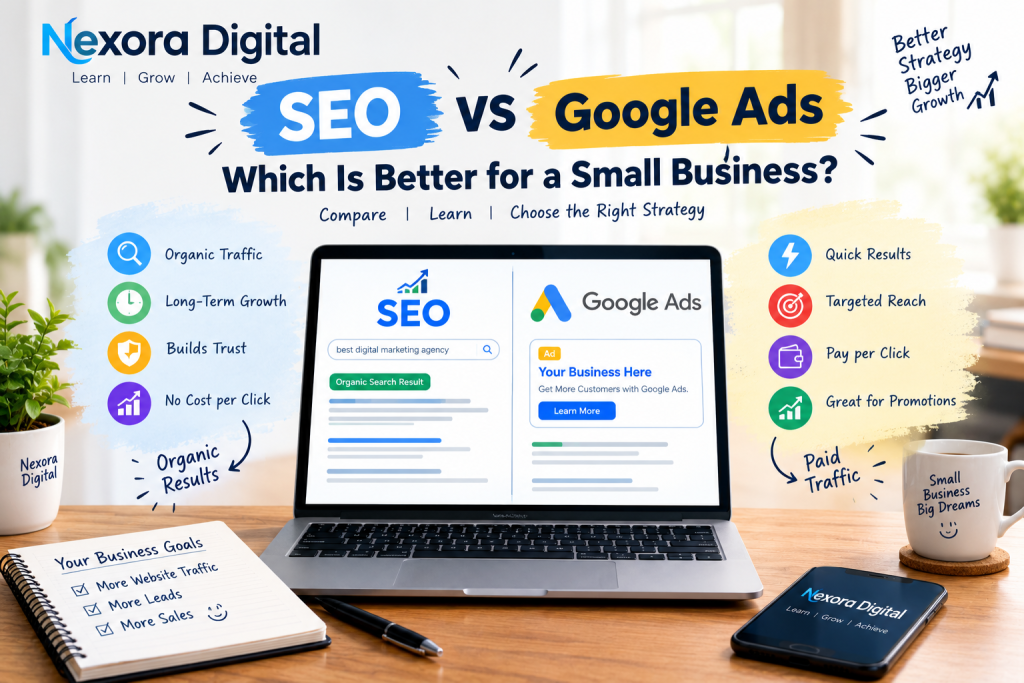
When a small business wants to grow online, one of the first questions that comes to mind is: Should I invest in SEO or Google Ads?
Both SEO and Google Ads can help businesses attract people through Google, but they work in very different ways.
SEO focuses on improving a website so that it can gain visibility in Google’s organic search results. Google Ads, on the other hand, allows businesses to pay for advertisements that can appear when people search for specific keywords.
For a beginner or small business owner, choosing between SEO and Google Ads can be confusing.
Should you focus on organic traffic? Should you spend money on paid advertising? Is SEO better for long-term growth? Can Google Ads provide faster results?
The answer depends on your business goals, budget, competition, website, target audience, and how quickly you need results.
In this guide, we will compare SEO vs Google Ads, explain how both strategies work, discuss their advantages and disadvantages, and help you understand which approach may be suitable for a small business.
What Is SEO?

SEO stands for Search Engine Optimization.
SEO is the process of improving a website and its content so that search engines can understand the website and show its pages for relevant searches.
For example, imagine you own a digital marketing agency in Delhi.
You may want your website to appear when someone searches:
“digital marketing agency in Delhi”
“SEO services in Delhi”
“Google Ads agency near me”
If your website has strong and relevant SEO, it may eventually appear in Google’s organic search results for some of these searches.
The important point is that you don’t pay Google for every organic click.
However, SEO requires time, consistent content, research, website optimization, and continuous improvement.
What Is Google Ads?
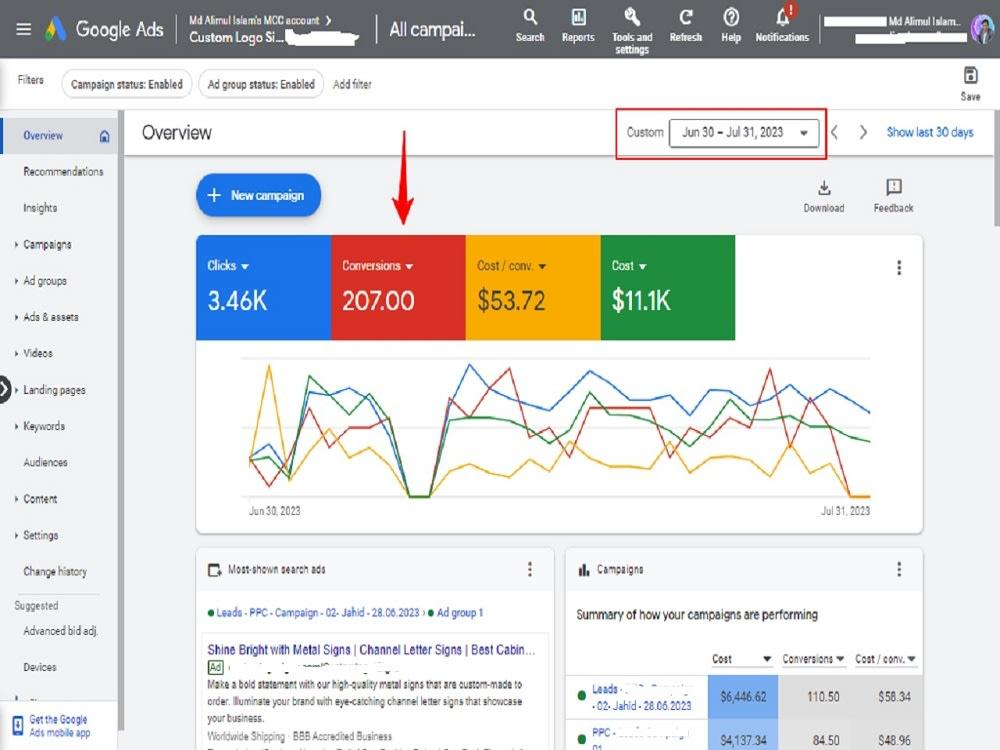
Google Ads is Google’s online advertising platform.
Businesses can create advertisements that may appear when people search for relevant keywords or interact with Google’s advertising network.
For example, if someone searches:
“best digital marketing course in Delhi”
a business may create a Google Ads campaign targeting relevant search terms.
The advertisement can appear near the top of the search results when the campaign is eligible.
The advertiser generally pays for advertising interactions according to the campaign setup.
Google Ads can therefore provide businesses with a way to reach potential customers without waiting for organic rankings.
SEO vs Google Ads: The Main Difference
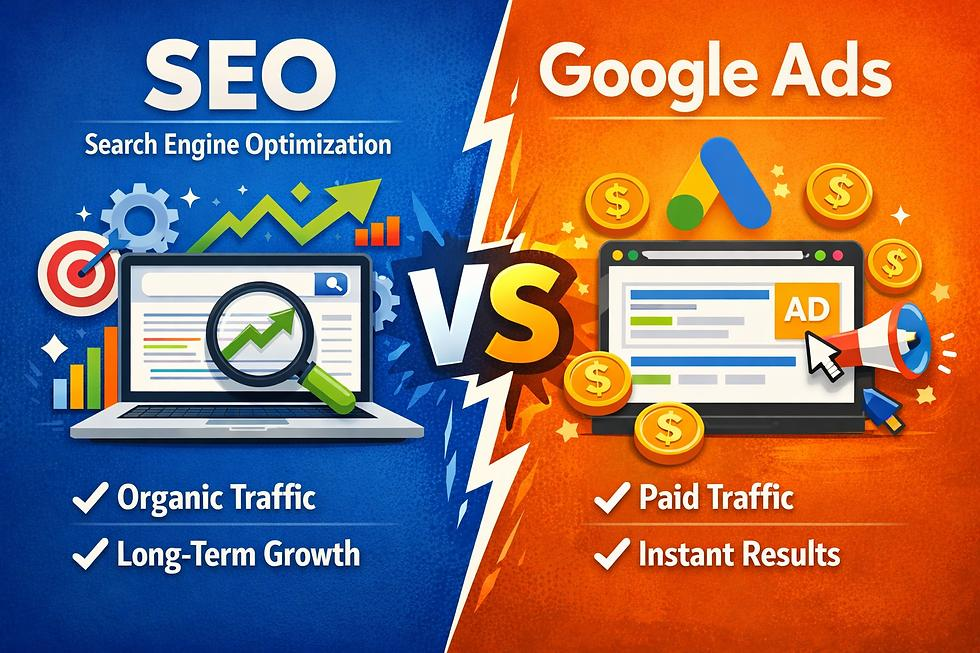
The biggest difference between SEO and Google Ads is simple:
SEO focuses on organic visibility, while Google Ads focuses on paid visibility.
With SEO, you invest time and resources into improving your website and content.
With Google Ads, you create an advertising campaign and set a budget to reach potential customers.
For example:
SEO:
Create useful content → Optimize website → Build authority → Improve rankings → Get organic traffic
Google Ads:
Create campaign → Choose keywords → Set budget → Run ads → Get paid traffic
Both can be valuable, but they serve different purposes.
SEO vs Google Ads Comparison
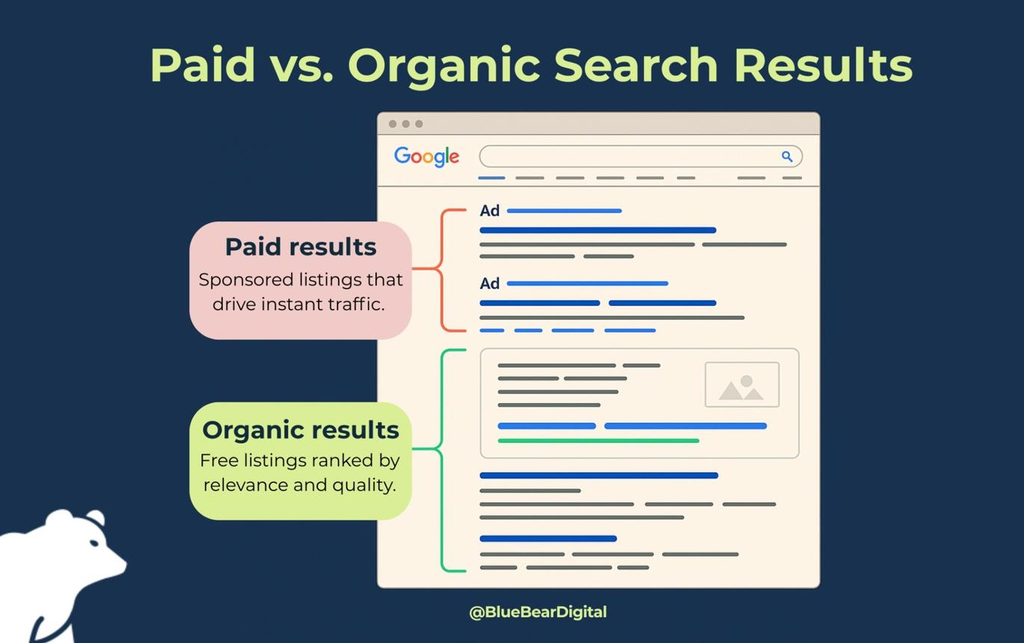
Here is a simple comparison.
SEO:
- Organic traffic
- No direct payment for every organic click
- Takes time to develop
- Can provide long-term visibility
- Requires content and website optimization
- Useful for long-term growth
- Rankings are competitive
Google Ads:
- Paid traffic
- Advertising budget required
- Can generate visibility quickly
- Campaign traffic generally stops when the campaign stops
- Requires ad creation and optimization
- Useful for immediate campaigns
- Performance depends on budget, targeting, competition, and ad quality
Neither strategy is automatically better for every business.
How SEO Helps Small Businesses
SEO can be particularly useful for small businesses that want to build long-term online visibility.
SEO Can Build Organic Visibility
A small business can create useful pages and blog posts targeting relevant searches.
For example, a local bakery could create content around:
- Best birthday cakes in Delhi
- Custom cakes in Delhi
- Chocolate cake delivery
- Birthday cake ideas
- Eggless cake options
If the content is useful and properly optimized, it may have an opportunity to appear in relevant searches.
SEO Can Support Long-Term Growth
SEO is generally a long-term strategy.
A useful article can continue attracting visitors after it is published.
However, this doesn’t mean every article will rank or that rankings will remain unchanged.
Competition, search behavior, website quality, and search engine systems can all affect performance.
SEO Can Help Build Trust
When people repeatedly discover a business through useful content and search results, it can help establish familiarity with the brand.
For example, a small digital marketing business that regularly publishes useful SEO and advertising guides can demonstrate knowledge of its subject.
SEO Can Support Local Businesses
Local SEO can be particularly important for businesses that serve a specific location.
Examples include:
- Restaurants
- Salons
- Coaching centers
- Repair services
- Clinics
- Local agencies
- Training institutes
A business can optimize its website and online presence around relevant local searches.
How Google Ads Helps Small Businesses
Google Ads has a different advantage.
It can help businesses reach potential customers through paid advertising without waiting for organic rankings.
Google Ads Can Provide Faster Visibility
One of the biggest advantages of Google Ads is speed.
A business can create a campaign, configure targeting and budget, and potentially start receiving relevant traffic once the campaign is approved and running.
This can be useful when a business has an upcoming promotion, new service, event, or time-sensitive offer.
Google Ads Can Target Specific Searches
Search campaigns can target relevant keywords and search themes.
For example, a business offering AC repair services in Delhi might target searches related to:
- AC repair near me
- AC service in Delhi
- Emergency AC repair
- Split AC repair
The exact targeting options and campaign setup depend on the current Google Ads system and campaign type.
Google Ads Gives Budget Control
Businesses can set campaign budgets and monitor performance.
For a small business, this can make paid advertising easier to test.
For example, a business might begin with a small daily budget, monitor results, and make changes based on performance.
However, having a budget does not guarantee profitable results.
Google Ads Can Be Useful for Lead Generation
Google Ads can be useful when a business wants users to take a specific action.
Examples include:
- Calling a business
- Filling out a form
- Booking an appointment
- Requesting a quotation
- Visiting a website
- Purchasing a product
The campaign should therefore have a clear goal.
Which Is Better: SEO or Google Ads?
There is no universal answer.
The better option depends on your business situation.
If you need faster visibility and have a budget available for advertising, Google Ads may be useful.
If your goal is long-term organic visibility and you can invest time in content and website optimization, SEO may be more suitable.
For many businesses, the best approach is not SEO vs Google Ads.
It is SEO + Google Ads.
When Should a Small Business Choose SEO?
SEO may be a good choice if:
- You want long-term organic visibility
- You have time to create useful content
- Your website needs stronger search visibility
- You want to build a content library
- Your business operates in a competitive online market
- You want to reduce dependence on paid traffic over time
- You can consistently improve your website
For example, a small education website could publish helpful articles every week.
Over time, these articles can target different questions and topics related to its services.
When Should a Small Business Choose Google Ads?
Google Ads may be useful when:
- You need traffic quickly
- You have a specific service to promote
- You have a defined advertising budget
- You want to test demand
- You have an upcoming offer
- You want to generate leads
- You want to reach people searching for specific services
For example, a local home appliance repair company may want to generate service calls immediately.
In such a situation, Google Ads could be useful because the company does not necessarily have to wait for months to build organic visibility.
SEO vs Google Ads: Which Is Cheaper?
This is another common question.
SEO is often described as free traffic because businesses don’t directly pay Google for organic clicks.
However, SEO is not completely free.
Businesses may spend money on:
- SEO professionals
- Content writers
- SEO tools
- Website development
- Website hosting
- Content creation
- Technical improvements
Google Ads requires an advertising budget.
Businesses pay for advertising interactions according to the campaign’s setup.
Therefore, instead of asking:
“Which one is free?”
a better question is:
“Which strategy provides the best return for my business goals and resources?”
SEO vs Google Ads: Which Gives Faster Results?
Google Ads generally provides faster visibility because businesses can advertise through paid campaigns.
SEO usually takes longer.
A new website may need time to build content, authority, relevance, and organic visibility.
However, faster traffic doesn’t automatically mean better results.
For example, Google Ads might bring 100 visitors to a website, but if the landing page is poor and the offer is unclear, those visitors may not become customers.
Similarly, a website may receive organic traffic through SEO, but if that traffic doesn’t match the business’s target audience, it may not generate useful leads.
The quality and relevance of traffic matter.
SEO vs Google Ads for a New Website
If you have a completely new website, you can consider using both strategies.
Start by building the foundation:
- Create important website pages
- Make the website mobile-friendly
- Optimize page titles
- Create useful content
- Set up analytics
- Set up Search Console
- Research relevant keywords
At the same time, if you have an advertising budget, you can test Google Ads for highly relevant services.
This allows you to work on long-term SEO while also testing paid traffic.
Can SEO and Google Ads Work Together?
Yes.
In fact, using both can provide useful insights.
For example, Google Ads can help you understand which search terms generate clicks or conversions.
Those insights can potentially inform your broader content and SEO strategy.
Similarly, strong organic content can provide useful landing pages and resources that support a broader digital marketing strategy.
The two channels don’t have to operate separately.
Example: A Small Digital Marketing Agency
Imagine a small digital marketing agency in Delhi.
The agency offers:
- SEO
- Google Ads
- Social media marketing
- Website development
The agency wants more clients.
SEO Strategy
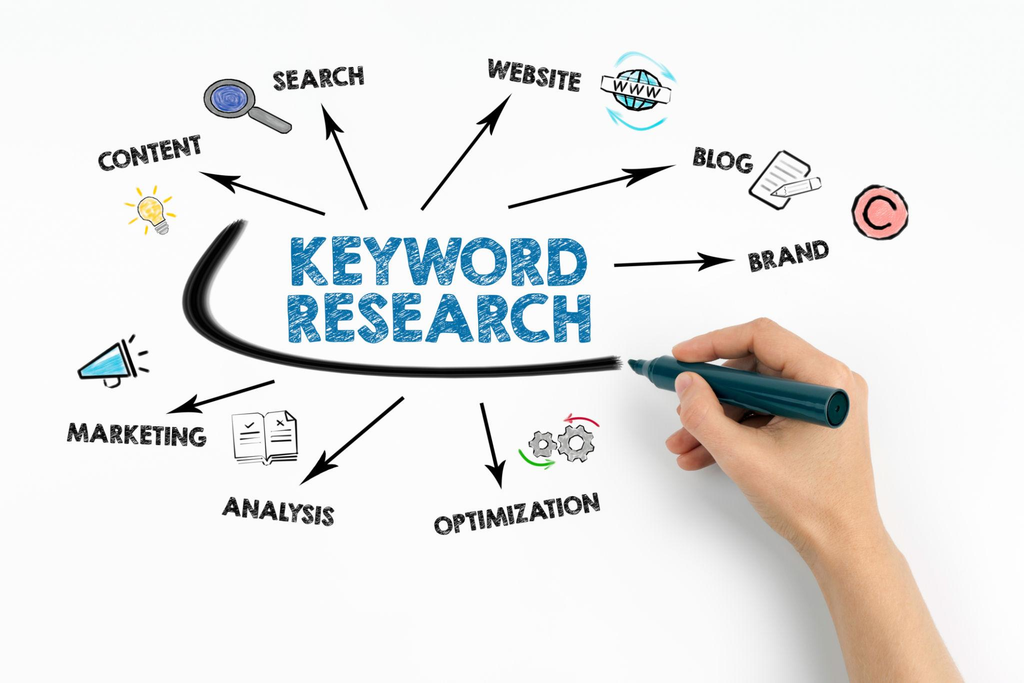
The agency creates pages and blogs around topics such as:
- SEO services in Delhi
- Google Ads services in Delhi
- Digital marketing for small businesses
- SEO for beginners
- How Google Ads works
- Social media marketing tips
These pages can help build organic visibility over time.
Google Ads Strategy
The agency can also create a paid campaign targeting relevant commercial searches.
For example:
“SEO agency in Delhi”
“Google Ads agency Delhi”
The campaign can send visitors to relevant service pages.
Now the agency is using:
SEO for long-term visibility
and
Google Ads for paid visibility and testing.
This can be more balanced than depending completely on one channel.
Common Mistakes Businesses Make With SEO
Expecting Immediate Rankings
SEO takes time.
Publishing one article does not guarantee a first-page ranking.
Keyword Stuffing
Repeating keywords excessively can make content difficult to read.
Use keywords naturally.
Ignoring User Intent
A page should answer the question or need behind the search.
Publishing Low-Quality Content
Publishing dozens of weak articles isn’t necessarily better than publishing fewer useful resources.
Focus on value.
Ignoring Technical Problems
Slow pages, broken links, poor mobile usability, and indexing problems can affect the overall website experience.
Common Mistakes Businesses Make With Google Ads
Choosing Irrelevant Keywords
Irrelevant keywords can waste advertising budget.
Choose search terms that are closely connected to your products or services.
Sending All Traffic to the Homepage
A specific advertisement should ideally take users to a relevant landing page.
For example, an ad for SEO services should preferably lead to the SEO service page rather than an unrelated page.
Not Tracking Conversions
Traffic alone isn’t enough.
Businesses should understand whether advertising leads to meaningful actions such as calls, forms, purchases, or bookings.
Stopping Without Analyzing
If a campaign isn’t performing well, don’t simply keep spending.
Review:
- Keywords
- Ads
- Landing pages
- Audience
- Search terms
- Budget
- Conversion data
Then optimize.
How to Decide Between SEO and Google Ads
Ask yourself these questions.
Do I Need Results Quickly?
If yes, Google Ads may be useful.
Do I Want Long-Term Organic Visibility?
If yes, SEO should be part of your strategy.
Do I Have an Advertising Budget?
If yes, Google Ads can be tested.
Can I Create Content Consistently?
If yes, SEO may be a strong long-term option.
Do I Have a Specific Service to Promote?
If yes, Google Ads may help you reach relevant searches faster.
Can I Use Both?
If your resources allow it, combining SEO and Google Ads can be a strong approach.
A Simple Strategy for Small Businesses
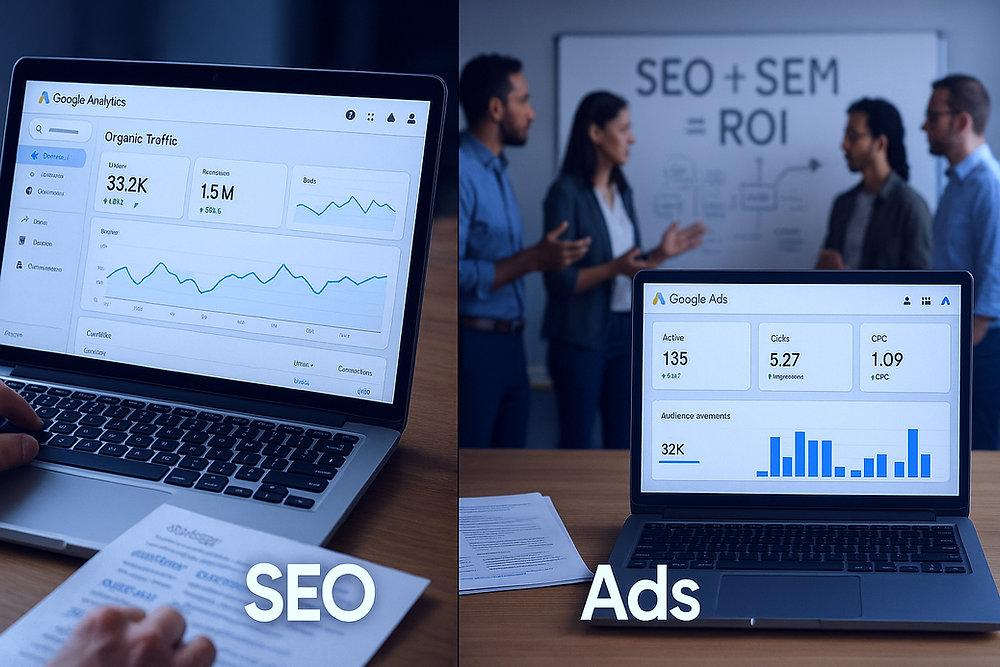
A beginner-friendly strategy could look like this:
Step 1: Create a professional website.
Step 2: Identify your most important services.
Step 3: Research relevant keywords.
Step 4: Optimize your service pages.
Step 5: Start publishing useful content.
Step 6: Set up Google Search Console and analytics.
Step 7: If you have a budget, test Google Ads with a small controlled campaign.
Step 8: Track leads and conversions.
Step 9: Improve your website based on data.
Step 10: Continue building organic visibility through SEO.
This approach allows a business to work on both short-term and long-term growth.
SEO vs Google Ads: Final Verdict
So, which is better?
The answer depends on your business.
Choose SEO if your priority is:
- Long-term growth
- Organic visibility
- Content marketing
- Sustainable search presence
- Building website authority
Choose Google Ads if your priority is:
- Faster visibility
- Immediate traffic
- Lead generation
- Promoting a specific service
- Testing a market or offer
Choose both if you want:
- Paid traffic
- Organic traffic
- Short-term visibility
- Long-term search growth
- More diversified digital marketing
For many small businesses, SEO and Google Ads should not be treated as competitors.
They can work together as two different parts of a digital marketing strategy.
How SEO and Google Ads Fit Into My Digital Marketing Learning Journey
As someone learning digital marketing, understanding both SEO and Google Ads is valuable.
SEO teaches you how websites, keywords, content, search intent, and organic visibility work.
Google Ads teaches you about paid search, campaign structure, targeting, advertisements, budgets, keywords, landing pages, and performance tracking.
While building Nexora Digital, my personal digital marketing portfolio website, I can use these concepts as practical learning opportunities.
Instead of only learning theory, creating websites, writing SEO blogs, researching keywords, and practicing advertising strategies can help develop real-world digital marketing skills.
The goal is not to claim that every practice project produces business results.
The goal is to learn, practice, analyze, and improve.
Final Thoughts
SEO and Google Ads are both powerful digital marketing strategies, but they work differently.
SEO focuses on building organic visibility over time.
Google Ads focuses on paid visibility and can provide faster access to relevant search traffic.
For a small business, the right choice depends on budget, goals, competition, website quality, audience, and timeline.
If you are just starting, don’t worry about choosing one strategy forever.
Start with the fundamentals.
Learn SEO.
Understand Google Ads.
Practice both.
Track what happens.
Then use your data to decide where to invest more time and money.
Digital marketing is not about finding one perfect strategy.
It is about understanding your audience, testing different approaches, measuring results, and continuously improving.
Learn → Practice → Test → Analyze → Improve.
That is the mindset that can help a beginner build strong digital marketing skills.
Frequently Asked Questions
Is SEO better than Google Ads?
Neither is automatically better. SEO is useful for long-term organic visibility, while Google Ads can provide faster paid visibility.
Is Google Ads faster than SEO?
Generally, Google Ads can provide faster visibility because it is a paid advertising channel. SEO usually requires more time to build organic visibility.
Is SEO free?
Organic search clicks do not require paying Google for each click, but SEO still requires time, effort, content, tools, and website optimization.
How much does Google Ads cost?
There is no single fixed cost. Advertising costs depend on factors such as keywords, competition, targeting, bidding, industry, campaign settings, and budget.
Can a small business use SEO and Google Ads together?
Yes. Many businesses can use SEO for long-term organic growth while using Google Ads for paid campaigns and faster visibility.
Which is better for a new website?
A new website can benefit from building a strong SEO foundation. If the business has an advertising budget and needs faster visibility, Google Ads can also be tested.
Does Google Ads improve SEO rankings?
Running Google Ads does not directly make your organic search rankings higher. Paid advertising and organic search rankings are separate systems.
How long does SEO take?
There is no guaranteed timeline. Results depend on competition, content quality, website authority, technical factors, search intent, and many other factors.
Should beginners learn SEO or Google Ads first?
SEO is often a good starting point for understanding keywords, search intent, websites, and organic search. After understanding the basics, beginners can learn Google Ads as another important digital marketing skill.
Can SEO bring customers without advertising?
Yes, SEO can bring organic visitors and potentially customers, but traffic and conversions depend on factors such as search intent, website quality, competition, offers, and the relevance of the traffic.